


.svg)
.svg)

.svg)
.svg)
.svg)

.svg)

.svg)
.svg)
.svg)
.svg)
.svg)
.svg)
7 Reasons Why AI Alone Won’t Solve Deduction Management Challenges
Yuval Selik
12 August 2026
AI is already changing deduction management for CPG brands, and that’s a good thing. It can speed up matching, surface patterns, reduce manual work, and help teams operate more efficiently. But the growing promise that AI can fully automate deductions misses a critical reality: this work is too complex, contextual, and financially consequential to remove experienced people from the process.
TL;DR
- AI is a powerful tool for deduction management, but it should augment experts...not replace them.
- Deductions depend on messy data, retailer-specific rules, contracts, promotions, broker relationships, and business context that AI can easily misinterpret.
- Small automation errors can compound over time, leading to inaccurate accruals, distorted trade spend reporting, and weakened confidence in financial performance.
- The strongest model is AI plus experienced deduction professionals who can validate outputs, catch exceptions, and make judgment calls.
- The real opportunity isn’t fully automating deductions - it’s combining better technology, better processes and human expertise.
There's no doubt that AI is transforming the way CPG brands work. It can summarize information in seconds, surface patterns across massive datasets, accelerate analysis, automate repetitive tasks, and help teams move faster than they could before.
At Promomash, we’re not watching that shift from the sidelines. We’ve been incorporating AI and machine learning into our technology and deduction management service for years...well before the current wave of AI-first deduction management vendors entered the market.
So *this is not* an argument against AI. It is an argument against overestimating what AI can do on its own. That distinction matters, especially in deduction management.
In a recent episode of the FoodBevy Startup to Scale podcast with Jordan Buckner, I shared a point of view that cuts against much of the current market narrative. I stated that there’s a hill I’m going to die on, and that is this: when it comes to deduction management, humans still must own 80% of it, while letting the tool do the other 20%.
Let me explain exactly what I mean by this (the percentages are less important than the principle behind them).
AI can make deduction management faster. It can make teams more efficient. It can help identify likely matches, aggregate information, flag patterns, and reduce manual work. However - deductions are too messy, contextual, interconnected, and financially consequential to simply hand them all over to a model and assume the output is right.
It's especially important to understand this as a new generation of vendors enters the category promising that AI can automate much of the process away. The promise is appealing. But the reality is more complicated.
Here are seven reasons why brands should be careful about treating AI as the answer to deduction management rather than as one part of a larger, well-thought-out trade management system and process.
1. Deduction management is not a clean data problem.
AI performs best when it has clean, consistent, well-structured data. Deduction management rarely offers that environment.
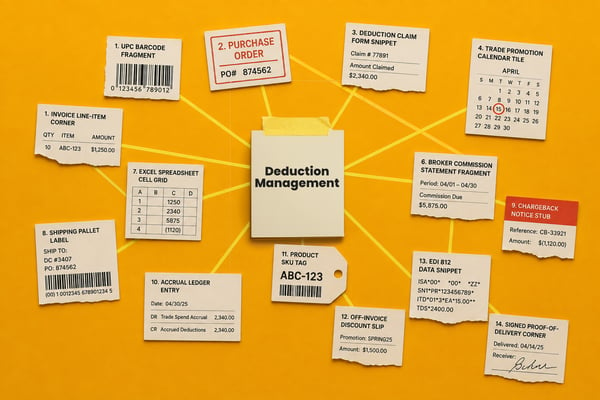
I like to compare the data challenges in CPG with Swiss Cheese. There are lots of holes in it because the information lives across distributor portals, invoices, contracts, promotional plans, broker communications, spreadsheets, emails, retailer programs, trade systems, and accounting records. Rarely are those data sources connected, leading to discrepancies everywhere.
A deduction may appear straightforward on the surface, but determining what it actually means can require understanding multiple pieces of context:
-
Which promotion was running at the time?
-
What did the retailer or distributor agreement actually say?
-
Was there an off-invoice allowance?
-
Was the charge related to a new-store opening, free fills, damaged goods, freight, shortage, compliance, or another program?
-
Were multiple charges applied against the same invoice?
-
Did the distributor recently change its codes or processes?
-
Was the deduction valid but indicative of a larger operational problem?
AI can process the documents, but it can't automatically manufacture the missing context. In the podcast episode, I emphasized that the largest opportunity for AI exists when brands have perfect data. But here's the problem: virtually no growing CPG brand has perfect data.
2. A deduction can be “correct” and still require human judgment.
One of the biggest misconceptions in deduction management is that every deduction falls neatly into one of two buckets: valid or invalid. Reality is rarely that simple. A deduction may be contractually valid while still exposing a problem elsewhere in the business.
Consider late-delivery penalties. The charge itself may be legitimate, but simply accepting and coding the deduction does not solve anything.
Someone still has to ask:
-
Why are deliveries late?
-
Is the problem happening with one distributor or across multiple accounts?
-
Is the warehouse creating the issue?
-
Is transportation performance deteriorating?
-
Is the retailer enforcing a policy differently than expected?
-
Should the operations team intervene?
The value comes not only from identifying what the deduction is, but from understanding what the deduction is telling you about the business. That requires judgment.
Software can surface the signal - but people still need to interpret what it means and decide what happens next.
3. Matching deductions to promotions is exactly where AI can help...but also where it can go wrong.
One of the clearest use cases for AI in deduction management is promotional matching. Today, teams can spend hours identifying which deduction corresponds to which promotion. AI can dramatically accelerate that process by looking at the available information and suggesting the most likely match. That is a real improvement. But it's also a good example of why human review still matters.
Imagine a brand ran several similar promotions with the same distributor within a short period. The amounts are close. The dates overlap. The retailer naming conventions are inconsistent. An AI system may confidently select one. But “probably correct” is not the same as correct.
If that deduction is matched to the wrong promotion, the error does not necessarily stay isolated to one invoice. It can affect the accrual, the remaining promotional balance, and GL coding. It can distort the brand’s understanding of trade effectiveness.
And once incorrect information starts flowing through downstream reporting, the problem compounds.
This is where Promomash draws a deliberate line: AI can help make the first pass faster, but a deduction should not simply move through the process without qualified human review.
In our view, the goal of automation is not to eliminate people. It's to eliminate unnecessary work so people can focus on decisions that actually require expertise.
4. The cost of being wrong can take months to appear.
One of the most dangerous things about over-automating deduction management is that mistakes may not be obvious immediately. A system can appear to be working beautifully for months. Invoices are being processed. Deductions are being matched. Reports are being generated. Work appears to be moving faster.
But then six months later, finance discovers that accruals are materially wrong.
Now the question becomes much bigger than whether one deduction was coded incorrectly...
-
How much trade spend was misallocated?
-
Are promotional liabilities understated or overstated?
-
Can the business trust its margin reporting?
-
Were decisions made using inaccurate customer profitability data?
-
Does the company need to restate internal forecasts?
-
What happens when management has to explain the discrepancy to investors, lenders, or the board?
For a growing CPG brand, financial credibility matters. Investors expect management to understand where cash is going. Finance teams need confidence in accruals. Leadership needs reliable information when making decisions about pricing, promotions, hiring, inventory, and fundraising. A small automation error repeated across thousands of transactions can become a material financial problem.
That is why “the AI got most of it right” is not necessarily a sufficient standard.
5. Distributor relationships cannot be reduced to a rules engine.
Deduction management is not only an accounting process. It is also a relationship process.
Every distributor behaves differently. Every broker works differently. Every retailer has its own programs, documentation standards, dispute procedures, codes, timelines, and unwritten realities. And those relationships matter when deciding whether and how to dispute a charge.
One example I raised during the podcast: what happens if an automated system starts aggressively disputing deductions with a distributor such as UNFI? If the system lacks context, it may decide that a large number of charges appear questionable and dispute them automatically.
From the software’s perspective, that may look efficient. But from the distributor’s perspective, your brand may suddenly be flooding the organization with disputes...some of which may be obviously valid to an experienced deduction professional. And that can damage credibility. Once credibility is lost, future conversations become harder.
An experienced professional understands what AI won't: that the technically available action is not always the strategically correct action.
AI does not inherently understand the history of the relationship, the personalities involved, the broker dynamics, the distributor’s current policies, or which battles are actually worth fighting. People do.
6. Brands often lack the expertise needed to audit the AI.
There is another flaw in the “fully automated” promise that receives far less attention: who checks the system?
Many growing CPG companies already struggle with deduction management because ownership sits with the wrong people - and/or there is a lack of truly experienced deduction pros on the team.
Salespeople are asked to match promotions. CFOs are digging through chargebacks. Founders are reviewing distributor invoices. Account managers are chasing documentation. Then an AI platform arrives promising to automate the process and reduce those burdens.
The brand understandably hands more responsibility to the system. But if nobody internally is a deduction expert, how does the company know whether the system is right?
That creates a dangerous circular dependency:
-
The brand adopts AI because it lacks the internal expertise to manage deductions.
-
Then it lacks the expertise required to validate the AI managing those deductions.
-
The system becomes the source of truth largely because nobody has enough experience to challenge it.
That is not automation. It's outsourced judgment. Not the same thing.
The better model combines technology with people who understand deductions deeply enough to recognize when the technology is wrong.
7. The future is AI plus experts, not AI versus experts.
None of the previous points diminish the importance of AI. It's quite the opposite.
AI is likely to become one of the most valuable productivity tools deduction teams have ever had. It can help:
-
Read and organize large volumes of documents.
-
Suggest promotional matches.
-
Identify patterns across deductions.
-
Surface anomalies.
-
Summarize distributor activity.
-
Accelerate coding workflows.
-
Reduce repetitive manual analysis.
-
Give experts better information faster.
Those are meaningful advances.
Here at Promomash we believe in them because we have been building with AI and machine learning for years.
But AI should enhance expertise - not create the illusion that expertise is no longer necessary.
Consider the evolution from a typewriter to a modern word-processing software. The software made writing dramatically easier. But it didn't eliminate the need for a writer.
The same principle applies here.
AI can help deduction professionals process information faster and make better decisions. But it can't replace the contextual understanding required to manage the entire process reliably.
Technology revolutions always attract companies promising that the new technology changes every rule overnight. Some of those companies will build valuable products. And some will push automation beyond where the technology is ready. Ultimately, the brands will ultimately bear the consequences of learning the difference.
The bigger opportunity: Stop treating deductions like cleanup.
There's one last important point from my conversation with Jordan that shouldn't get lost in the AI debate...
The best deduction strategy is not simply processing deductions faster. It's creating fewer mysteries to investigate in the first place.
Too many brands manage deductions reactively. Here's a play-by-play of what I've seen too many times:
1. Money arrives short.
2. Months later, someone investigates. They search through emails. Track down contracts. Ask salespeople what promotion was running.
3. Then they try to reconstruct what happened after the fact.
This reactionary exercise treats deductions like janitorial work - constantly cleaning up after something has already happened.
A more mature approach is proactive: before a promotion, launch, or distribution program begins, the brand understands the expected spend. Agreements are documented. Potential charges are understood. Accruals are established. Promotional plans are captured. So when a deduction eventually arrives, the team is not solving a mystery. They are comparing what happened against what was already expected.
That foundation matters far more than whichever AI model happens to be powering the software. Because tools do not fix broken processes - they amplify them. A strong process plus AI can create enormous leverage. A weak process plus AI can create errors faster.
The question brands should be asking about using AI for deductions...
The AI conversation in deduction management should not be: “Can AI process this?”
Increasingly, the answer will be yes.
The more important question is “Where should AI make the decision, and where should an experienced person remain accountable for the outcome?”
Those are very different questions. And for our team at Promomash, the answer is clear:
-
Use AI aggressively where it creates efficiency.
-
Use machine learning where it improves matching and analysis.
-
Use automation wherever repetitive work can safely be removed.
But when financial accuracy, distributor relationships, accruals, trade effectiveness, and business decisions are on the line, keep experienced people in the loop.
Because deductions are not just documents to process. They are financial events embedded in contracts, promotions, operational realities, relationships, and business strategy. Until AI can reliably understand ALL of that context - not just some of it - the smartest deduction strategy will be to pair good AI technology with great deduction people who know what they are looking at.