


.svg)
.svg)

.svg)
.svg)
.svg)

.svg)

.svg)
.svg)
.svg)
.svg)
.svg)
.svg)
Swiss Cheese Data: Why CPG Brands Struggle to Reconcile Deductions
Yuval Selik
8 October 2026
The Short Answer
CPG brands struggle to reconcile deductions because they try to validate claims with measurement data. Syndicated data, retailer POS, distributor depletions, consumer panel data, and direct sales each measure part of the business. A deduction gets settled against documents: the purchase order, the proof of delivery or bill of lading, the promotion on the trade calendar, and the signed term that authorized it. When those documents are missing or scattered, the trail goes cold, the deduction clears by default, and the brand pays for the same promotion twice.
Key Takeaways
- A deduction is a claim, and claims are settled with documents (PO, proof of delivery, deal sheet, signed agreement). Dashboards measure performance; they cannot adjudicate a charge.
- Depletions measure shipments out of the distributor warehouse. Forward buys and inventory moves change them even when no extra units sell.
- The agreements layer is where claims get settled. Distributor contracts, fee schedules, routing guides, deal sheets - and it's the layer that tends to get the least attention.
- Retailers can deduct 6 to 24 months after payment and auditors go back up to three years. Your dispute window is roughly 180 days at KeHE, and UNFI denies adjustments older than 12 months.
- The brand owns reconciliation. Brokers, distributors, and retailers are paid to do other things.
- A 15-minute trace of one deduction can show exactly where your ability to defend a dollar ends.
A founder called me in March. Her brand was growing. Depletions were up quarter over quarter, her broker was pleased with her, and she had five dashboards open on her laptop while we talked. She could not tell me what one line on her UNFI remittance was for. Not even roughly.
There was a charge, the charge had a code, the code pointed at a term in an agreement somebody had signed at some point, and that was where it stopped. She had spent two days on it. She had more data about her business than any brand had twenty years ago, and none of it answered the question.
I started a brand in 2006 and I have been on some version of this call ever since. The details move around. The shape does not. A founder with good numbers, growing distribution, and no way to tell whether the money coming off the top is owed.
The instinct is to call it a reporting problem and go looking for a better dashboard. I did that for years. It's not a reporting problem, and a sixth dashboard doesn't help.
Why can't CPG brands reconcile deductions with the data they already have?
The reason many brands can't reconcile deductions is because the data they rely on was built to measure performance, and a deduction has to be settled against documents: a purchase order, a proof of delivery, a deal sheet, and a signed agreement. The founder's data was not bad. It was just fine. The problem was that she was trying to settle an argument with a thermometer.
A deduction is a claim. Someone has decided you owe them money, for a stated reason, under a stated term. Claims get settled against documents — a purchase order, a bill of lading, a deal sheet, a signed agreement. Documents are what adjudication runs on, because a document is a record of what was agreed and what was done.
What she had open on her laptop were five measurement systems. Syndicated data, retailer POS, distributor depletions, a consumption panel, her own sales records. Every one of them measures, but not one of them adjudicates. You can't settle a parking ticket by showing how busy the street was that afternoon, and you can't settle a deduction by showing how the brand performed that month.
That is the whole problem in one line, and it is not a problem any amount of better measurement solves. A brand with five excellent measurement systems and no document trail is exactly as unable to answer the question as a brand with one bad one. It just feels better informed while it happens.
What are the five data layers CPG brands run on, and what can each one not see?
Most brands run on syndicated data, retailer POS, distributor depletions, consumer panel data, and their own direct sales. Each answers a different question well. None of them can confirm whether a specific deduction is owed. It's worth going through them, because each is genuinely useful for the job it was built for, and that is exactly why they are so easy to mistake for an answer.
-
Syndicated data tells you how the category is moving and where you sit in it. It does not cover every account, coverage varies by retailer and by channel, and what it reports is a modeled projection rather than a count of your cases.
-
Retailer POS is the closest thing to truth about what left the shelf, in the accounts that give it to you. Most do not, or give you a subset, on a lag, in their own format. You get a clear view of a few doors and nothing about the rest.
-
Distributor depletions tell you what moved out of the warehouse. This is the number most brands quote in board meetings, and it is not demand; it's a shipment. Forward buys, a distributor working its own inventory position, a reset — all of them move depletions without a single additional unit leaving a shelf.
-
Consumption panel tells you who is buying and why, which is the only layer that explains behavior. It is a sample, projected. It is directionally valuable and it will never reconcile to a case count.
-
Direct sales is the one set of records you fully control. It is also the narrowest, and it ends at your dock.
|
CPG data layer |
What it tells you |
What it cannot tell you |
Example sources |
|
Syndicated |
Category position, share, trend |
Uncovered accounts; actual cases |
NielsenIQ, Circana, SPINS |
|
Retailer POS |
Real sell-through, where available |
Anything about accounts that do not report |
Walmart Luminate, Kroger 84.51, Target, Albertsons |
|
Distributor depletions |
Shipment volume, distributor activity |
Whether anything sold |
UNFI, KeHE, beverage distributors via VIP |
|
Consumption panel |
Who buys, repeat, why |
Case-level reconciliation |
NielsenIQ Homescan, Circana Consumer Network |
|
Direct sales |
What you invoiced |
What happened after the dock |
Amazon, Shopify, DSD, club first-party |
Five layers, five different jobs, five honest answers to five different questions. None of them is the question she was asking.
What is the Swiss cheese data problem in CPG?
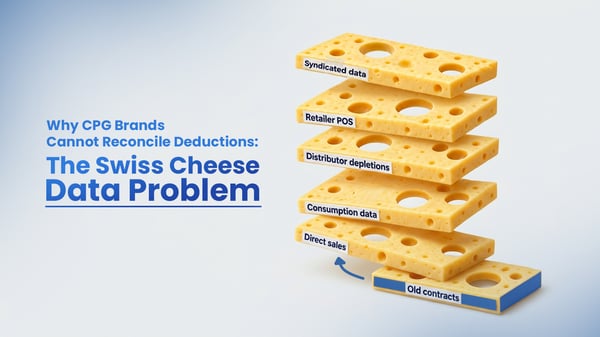
Swiss cheese data is our name for how a CPG brand's records stack up. Each layer captures only part of what happened; the gaps sit in different places, and nobody can see through the stack from a charge on a remittance back to the term that authorized it.
Our use of the term "Swiss cheese data" was inspired by James Reason's Swiss cheese model describing layered defenses. My co-founder, Chris Ambarian, began using it to describe CPG data challenges. It's worth being exact about what he means, because it is an inversion of Reason's model.
Each layer has holes. Most of the time the holes sit in different places and a hazard is stopped by one layer or another. Disaster happens when the holes line up and the hazard passes straight through every layer at once.
Our layers are not defenses. They are records. Each one captures part of what happened, from one angle, for one purpose. And that changes which direction the failure runs. In Reason's model, you worry about what comes through the holes. In ours, you worry about what you cannot see through them.
Both things are happening at the same time, which is why this gets muddled. The deduction does come through. It arrives, nothing stops it, and it clears — that part is Reason exactly, a stack of defenses with no depth. But the reason nothing stops it is that nobody can look the other way through the stack. There is no line of sight from the charge on the remittance back to the term that was signed.
Reason's question is whether something should have been let through. Ours is whether anything can be reconstructed. And the second question comes first, because you cannot judge a claim you cannot rebuild.
What documents do you need to validate or dispute a deduction?
To validate or dispute a deduction you need the retailer or distributor PO, the proof of delivery or bill of lading, the promotion on your trade calendar, the deal sheet, and the current version of the contract term or fee schedule the charge is coded to.
Underneath the five is the one that actually matters for this: the agreements. Distributor contracts, fee schedules, routing guides, deal sheets, the terms somebody negotiated two years ago and filed in an inbox. This is where claims get settled, and it is the layer brands keep worst.
Terms get signed by whoever was in the role at the time. Fee schedules and routing guides get revised on the distributor's calendar, not yours, so the copy you downloaded at onboarding went stale without telling you. Emerging brands lose money to UNFI and KeHE less through error than through never having understood how double markups, forward-buying and manufacturer chargebacks land in gross-to-net.
How long do retailers and distributors have to deduct, and how long do you have to dispute?
Then there is the deduction dispute clock, which I would hang on a wall if I were running a trade desk today. Here are some approximate timelines to take note of:
-
Post-audit deductions arrive 6 to 24 months after payment.
-
Third-party audit firms go back up to three years, by which point your own records may be out of reach — and a meaningful share of those claims turn out to be wrong or excessive.
-
KeHE gives you roughly 180 days from the deduction date to push back.
-
UNFI denies adjustments older than 12 months, with no escalation path through the portal.
Their window to claim is measured in years while yours to dispute is measured in months. That asymmetry is not an accident of system design. A deduction arrives, coded to a term nobody currently employed has read, inside a window nobody is counting. Nobody can tie it out. It clears. You paid for that promotion once on the invoice, and now you have paid for it again.
This is the single most actionable thing in this article: if you do nothing else, find out what your actual dispute windows are and who in your building is watching them.
Who is responsible for reconciling deductions at a CPG brand?
Reconciling deductions falls on the CPG brand or manufacturer, and inside the company it belongs with finance: a controller, AR lead, or dedicated deduction analyst who isn't paid on sales volume. This may be contrary to what many brands actually realize or believe, so let me explain.
Your broker is paid on what ships, which is the depletion number — the one we defined earlier in this article. This is not demand. So the number your broker is compensated on is the number that tells you least about whether the promotion worked. And in most cases you agreed to that commission structure, which is what makes it worse than a simple misalignment. You are paying someone to maximize the one figure that answers none of your questions.
Then something worse tends to happen. There is usually nobody in the building whose actual job is attribution and reconciliation, so the work drifts to whoever is available and sounds confident about trade. Often that is a salesperson. Either they get handed a piece of it, or they come in asking for a promotion and nobody has the standing to say no. Approval and policing of trade spend have now landed with the one person compensated to maximize it.
That is not a character flaw and it is not worth being annoyed about. They are doing the job you are paying them to do, well. It is simply that the arrangement produces the opposite of what you need, and it produces it reliably.
Your distributor is paid to move pallets and collect fees, and several of those fees are the deductions in question. Your retailer protects its own margin, and a deduction is a line on its P&L, not yours. None of these parties is badly behaved. None of them is paid to reconcile your data. More to the point, you should not want them to — expecting your distributor to tell you what you are owed is like expecting the other side's lawyer to organize your evidence.
The numbers are not small. Trade spend commonly runs 15 to 25 percent of gross sales. Retailer deductions and chargebacks alone have been put at 5 to 15 percent, although across many of our deduction management clients that number has approached closer to 20 percent. A single deduction can take 30 to 60 minutes to review manually, which is why so many small lines get written off without anyone opening them. One full hour of someone's time to investigate a two-hundred-dollar charge — to maybe recover a fraction of it if the paperwork holds — and to still not be able to say whether the promotion worked.
There is a sixth data layer, too, and it decides whether you are on the shelf at all: item data, GTINs, case packs, dimensions. That is a different article. For this one, bad item data keeps you off the shelf, and bad data across these six layers keeps you paying for the shelf twice.
How do you trace a deduction back to its source?
Pick one deduction from last month. Not the biggest one. Any one. Then run a single-deduction trace. Follow one recent deduction back through five matches, from the PO to the signed term. The first match you cannot make is the gap to fix.
This is the exercise I give every founder who asks me about this, and it takes fifteen minutes. Here's how to do it:
-
Match the deduction to the retailer or distributor PO.
-
Match the PO to the delivery receipt or bill of lading.
-
Match the delivery to the distributor depletion record.
-
Match the period to your trade calendar.
-
Match the promotion to the signed term that authorized it.
Most people stop somewhere between three and five. Wherever you stop is the answer — not to where your data is weak, but to where your ability to defend a dollar ends.
This exercise does not require better data, a new platform, or anyone's permission. It only requires one deduction and fifteen minutes, and it will tell you something about your business that no dashboard on your laptop will.
How much do untraceable deductions cost a CPG brand?
Untraceable deductions cost so many CPG brands more than they realize because the cost never appears as its own line in the P&L.
Take the deductions you absorbed last quarter. Now estimate the share you did not contest because you could not reconstruct them in the time available. That is the number. It appears nowhere in your P&L as its own line, which is precisely why it survives year after year. It's not a crisis, and never triggers anything.
In 20 years I have almost never watched a brand die from one catastrophic event. What I have watched, many times, is a brand lose two or three points of margin a year to charges nobody could tie out, until the business that should have been fundable was not.
So trace one deduction this week. If the trail goes cold, you now know something specific and useful, and you did not need us to find it out. But if you would rather not do it alone, we can help.
Frequently asked questions